
Borehole Magnetic Survey Prices 2026: Why Magnetic Survey Cost Matters in Site Exploration in Pretoria, East, North, West, Centurion & Tshwane
Borehole Magnetic Survey Prices are vital for finding water in South Africa’s dry landscape. They guide us to hidden water sources underground. Let’s explore the costs of these surveys across the country.
We’ll look at prices from busy Gauteng to the vast Northern Cape. These surveys are changing how we access water in our nation.
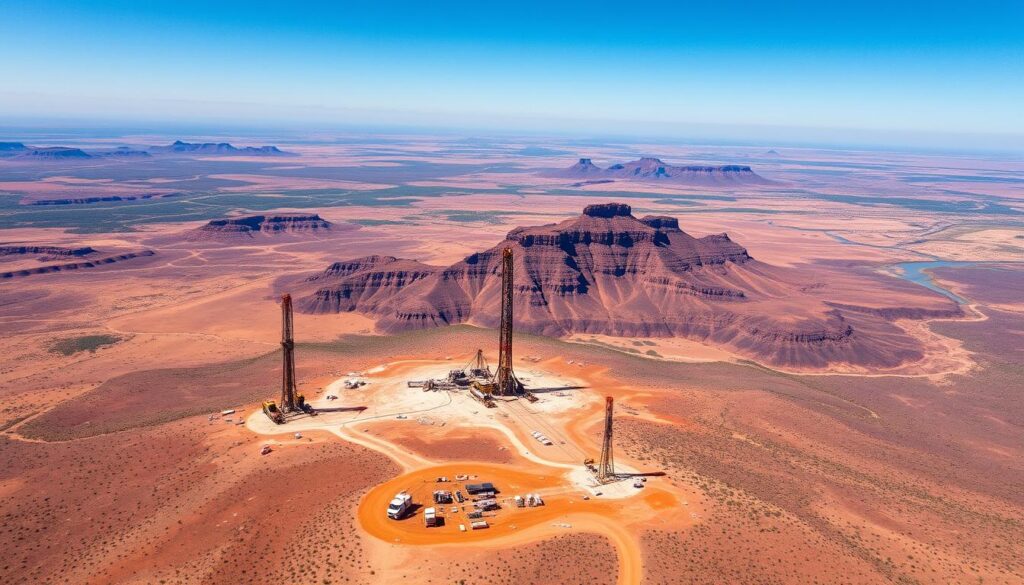
In the Northern Cape, 72% of towns depend on groundwater. Drilling costs range from R300 to R500 per metre. Complete installations can cost between R50,000 and R100,000.
Geophysical magnetic surveys might seem costly at first. However, they’re a wise investment compared to the expense of a failed borehole. These surveys can increase your chances of finding water by 80%.
Let’s delve into the details of magnetic survey rates in South Africa. We’ll uncover costs, benefits, and regional differences shaping our nation’s water future – Contact Us
Borehole Magnetic Survey Prices: Understanding Magnetic Surveys for Borehole Development
Magnetic surveys are vital for borehole development. They provide precise insights into groundwater exploration. Advanced equipment maps underground formations, improving our ability to locate water-bearing zones.
Benefits of Magnetic Surveys in Groundwater Exploration
Magnetic surveys offer key advantages for groundwater exploration. They precisely identify water-bearing formations and are cost-effective compared to traditional methods.
In South Africa, where fractured aquifers are common, these surveys help determine borehole yield potential.
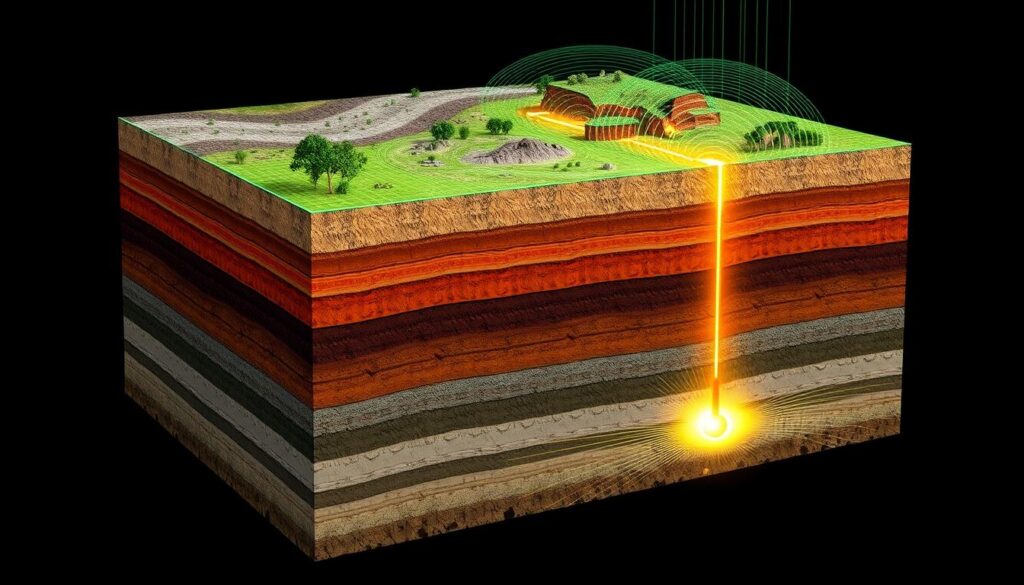
Technical Components and Equipment Overview
Magnetic survey equipment includes transmitters, receivers, data loggers, and coil pairs. These tools measure the Earth’s magnetic field and detect anomalies indicating water-bearing formations.
Our surveys often use total magnetic field measurements. We take readings at 10–100 metre intervals, averaging 50 metres.
Survey Depth Capabilities and Limitations
Magnetic survey depth coverage depends on the technique used. Surface EMI methods can reach depths from sub-meter to 1,000 metres.
Airborne EMI and TDEM methods typically cover up to 300 metres. Our studies show overburden thicknesses from 4.41 to 29.4 metres.
These findings closely match actual well depths of 5.48 to 27.1 metres. Understanding these capabilities is crucial for effective borehole planning.
This technology can significantly reduce the nonproductive hole rate. Currently, it stands at 40.4% in some areas of South Africa.
Magnetic Survey Prices and Cost Components – Borehole Magnetic Survey Prices
Magnetic survey pricing in South Africa depends on various factors. These include base prices, additional costs, regional differences, and seasonal changes. Let’s explore how these elements affect survey rates across the country.
Base Price Ranges per Square Kilometre
In South Africa, magnetic survey costs typically range from R500 to R1,500 per square kilometre. The price reflects the survey’s complexity and the equipment used. Ground magnetic surveys are usually cheaper than aerial surveys.
| Survey Type | Price Range (per km²) |
|---|---|
| Ground Magnetic | R500 – R800 |
| Aerial Magnetic | R1,000 – R1,500 |
Additional Cost Considerations
Several factors can increase the overall magnetic survey cost. These include mobilisation fees for equipment and personnel. Data processing and interpretation charges also add to the expense.
Terrain accessibility and survey area size are other important considerations. Difficult-to-reach areas or larger surveys may cost more.
- Mobilisation fees for equipment and personnel
- Data processing and interpretation charges
- Terrain accessibility and survey area size
Regional Price Variations
Magnetic survey pricing can vary across South African provinces. The Northern Cape often has higher rates due to its unique geology. Urban areas might have lower costs because of better infrastructure and accessibility.
Seasonal Price Fluctuations
Seasonal changes can affect magnetic survey rates in South Africa. Prices may rise during drier months, which are peak exploration seasons. This increase is due to higher demand for survey services.

Knowing these factors helps in budgeting for magnetic surveys accurately. For precise pricing, it’s best to consult experienced providers. They can give you specific costs for your project in South Africa.
Provincial Survey Pricing Analysis – Borehole Magnetic Survey Prices
Magnetic survey prices vary significantly across South African provinces. Local factors and new technologies influence these pricing structures. Our analysis reveals interesting patterns in different regions.
In Gauteng, magnetic survey prices Johannesburg reflect the complex urban landscape. Costs range from R9,500 to R13,000 per square kilometre. This accounts for dense infrastructure and potential interference sources.

The Western Cape tells a different story. Magnetic survey prices Cape Town are slightly lower, from R8,000 to R11,500 per square kilometre. This pricing considers the region’s diverse geology and coastal influences.
KwaZulu-Natal takes an innovative approach. Magnetic survey prices Durban benefit from solar-powered technology use. Costs range from R8,500 to R12,000 per square kilometre. This eco-friendly solution cuts operational costs and boosts survey efficiency.
| Province | Price Range (per km²) | Key Influencing Factor |
|---|---|---|
| Gauteng | R9,500 – R13,000 | Urban infrastructure |
| Western Cape | R8,000 – R11,500 | Diverse geology |
| KwaZulu-Natal | R8,500 – R12,000 | Solar technology adoption |
These price differences show the importance of local conditions in survey budgeting. Advanced technologies and region-specific challenges shape final costs. South Africa’s diverse landscape plays a crucial role in determining survey prices.
Technology Impact on Survey Costs – Borehole Magnetic Survey Prices
Magnetic survey technology is rapidly changing, affecting groundwater exploration costs. New equipment and data processing methods are altering rental prices and project expenses.
Modern Equipment and Price Implications
Modern magnetic survey tech has boosted data quality and efficiency. Ground-based low-frequency EM systems cost from R100,000. Airborne EM systems can reach R2,000,000.
These prices reflect the improved capabilities of new equipment. The higher initial investment is often justified by better results.
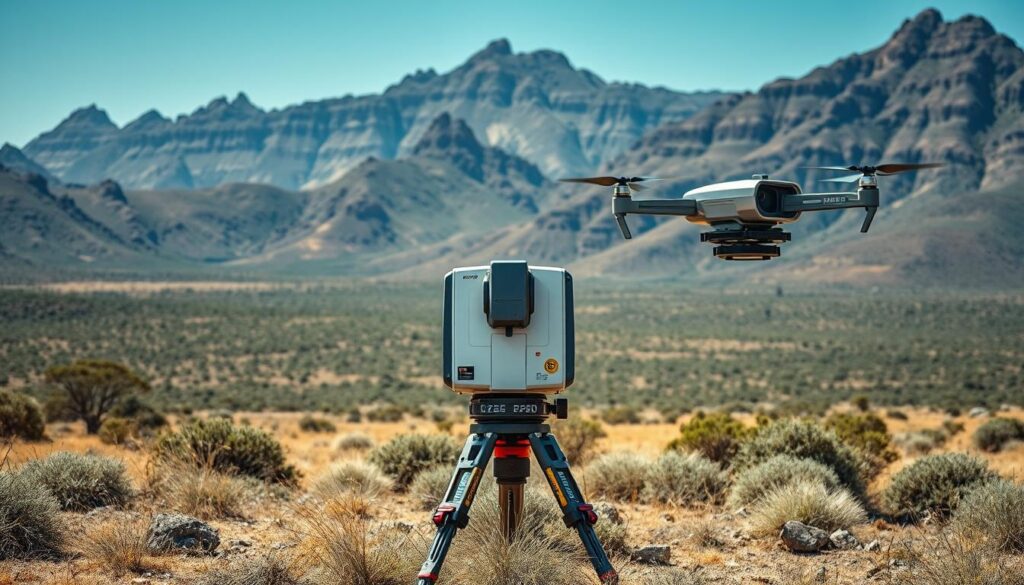
Data Processing and Analysis Costs
Magnetic data acquisition now includes advanced processing techniques. For large surveys, data acquisition averages R170 per kilometre. Processing costs range from R67 to R90 per kilometre.
A 10,000 to 20,000 line kilometre survey takes about two to three months. This includes processing, analysis, and interpretation.
Advanced Technologies and Future Price Trends
AI and machine learning are set to transform magnetic surveys. These new tools may lower costs and improve data interpretation accuracy.
The SUMO cart system offers better resolution and accuracy. This could make magnetic surveys more affordable and effective in future.
| Technology | Cost Range | Benefits |
|---|---|---|
| Ground-based EM | R100,000 – R500,000 | Cost-effective, versatile |
| Airborne EM | R1,000,000 – R2,000,000 | Rapid coverage, high resolution |
| AI-enhanced processing | R50,000 – R200,000 | Improved accuracy, faster results |
Survey Coverage and Depth Options – Borehole Magnetic Survey Prices
Magnetic survey coverage and depth are vital for groundwater exploration. We offer various packages to suit different projects in South Africa. Our basic packages start at R2,500 for a 30-metre depth.
High-resolution surveys cost between R10,000 and R25,000. These provide deeper penetration and more detailed data for complex projects.
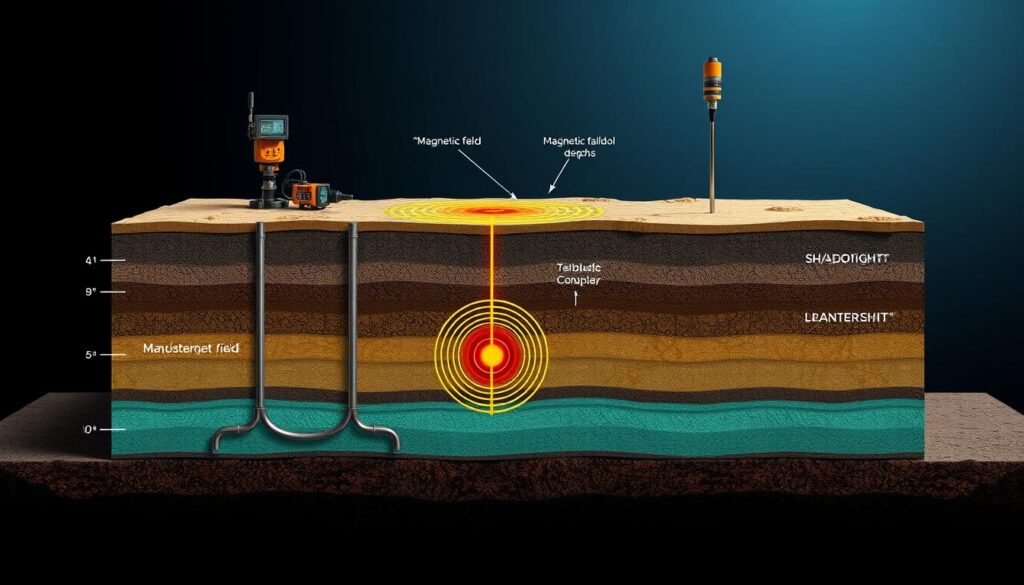
Survey depth depends on the equipment used. Ground surveys with Proton Precession Magnetometers (R50,000 – R150,000) offer excellent shallow coverage. Airborne surveys using Optically Pumped Magnetometers (R200,000 – R500,000) can reach 300 metres deep.
Borehole logging with Fluxgate Magnetometers (R100,000 – R300,000) gives precise depth measurements in existing wells. The choice of depth affects pricing.
In KwaZulu-Natal, basic surveys cost R150 per m². Advanced surveys are R250 per m². The Eastern Cape has slightly lower rates.
“For capturing details about the anomalous field, surveying should consist of at least 3 points per halfwidth of the signal.”
Coverage area is crucial too. Effective surveys should extend beyond the target area. This ensures full capture of anomalous signals.
Our surveys range from 4m² to 64m². Larger coverage areas provide more comprehensive data. Balancing coverage and depth is key to successful groundwater exploration.
Cost-Effectiveness and Investment Returns – Borehole Magnetic Survey Prices
Magnetic surveys offer remarkable financial benefits for borehole development. They transform groundwater exploration projects across South Africa. Our analysis reveals their cost efficiency and impact.
Long-term Financial Benefits
Magnetic surveys yield substantial returns on investment. The industry is projected to grow to USD 21.62 billion by 2029. Our best price guarantee ensures you benefit from this growth affordably.
Success Rate Analysis
Magnetic surveys significantly improve borehole success rates. They can increase accuracy by up to 80% compared to traditional methods. This boost in precision leads to considerable cost savings over time.
| Method | Success Rate | Cost-Efficiency |
|---|---|---|
| Magnetic Survey | Up to 80% | High |
| Traditional Methods | Varies | Lower |
Cost Comparison with Traditional Methods
Magnetic surveys often exceed a 14:1 return on investment ratio compared to conventional techniques. This impressive figure highlights the cost efficiency businesses can achieve with magnetic surveys.
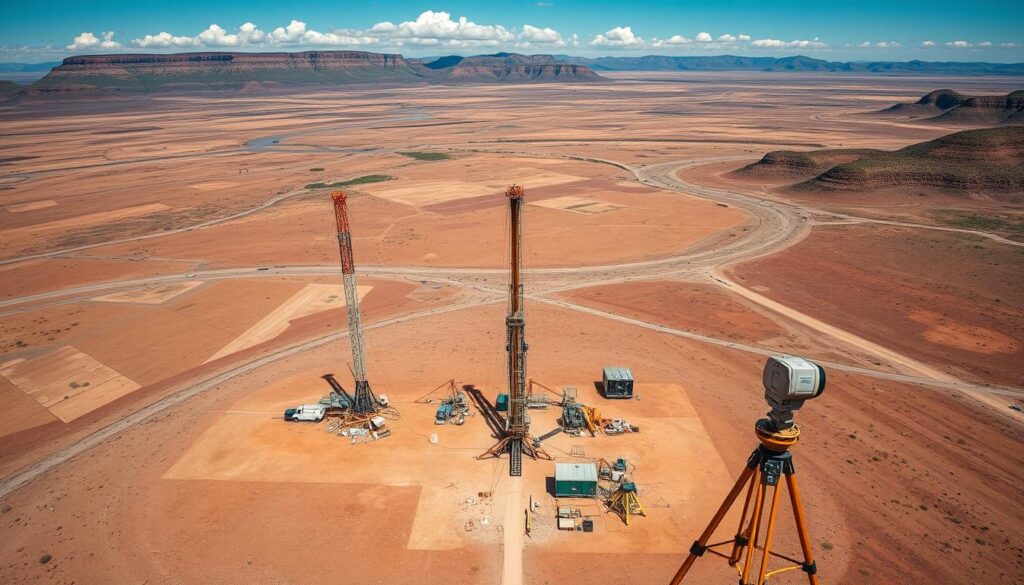
Integrating magnetic surveys with drilling programmes optimises resource allocation. This approach enhances project efficiency from site selection to drilling completion. It maximises cost savings throughout the entire process.
Borehole Magnetic Survey Prices: Conclusion
Magnetic survey costs in South Africa vary greatly across provinces and cities. Basic surveys start at R600 per metre. Comprehensive assessments can exceed R50,000, reflecting the expertise and technology involved.
A pricing calculator helps project planners budget effectively. Key factors include survey depth, geological conditions, and equipment used. UAVs can reduce costs for smaller areas, while aircraft suit larger projects.
The benefits of magnetic surveys often outweigh the initial investment. They can pinpoint water sources accurately, saving money on unnecessary drilling. Avoiding five unsuccessful boreholes could save up to R15,00,000 in costs.
A total survey cost might reach R34,84,100. However, potential savings and increased success rates make it worthwhile. This is especially true in South Africa’s water-scarce environment.
Understanding these cost factors is crucial for water management projects. Advancing technology and growing water scarcity increase the importance of magnetic surveys. They offer a path to more sustainable water resource management across South Africa.
FAQ
1. What is the average cost of a magnetic survey for borehole development in South Africa?
Magnetic surveys for borehole development in South Africa typically cost between R500 and R1,500 per square kilometre. Factors like location, survey depth, and technology can affect the price.
2. How do magnetic survey prices differ across South African provinces?
Prices vary across provinces due to geological differences and local conditions. In KwaZulu-Natal, costs range from R8,500 to R12,000 per square kilometre. The Northern Cape has higher prices, ranging from R9,000 to R13,500, due to its arid landscape.
3. What additional costs should I consider when budgeting for a magnetic survey?
When budgeting, consider mobilisation fees, data processing charges, and interpretation costs. These extras can significantly impact your overall project expenses.
4. How deep can magnetic surveys penetrate?
Survey depth varies based on the technique used. Surface EMI surveys can reach depths from sub-meter to 1,000 meters. Airborne EMI and TDEM methods can penetrate up to 300 meters.
5. Are magnetic surveys cost-effective for borehole development?
Magnetic surveys are cost-effective for borehole development. They can boost success rates by up to 80%. This offers a potential return on investment exceeding a 14:1 ratio compared to traditional methods.
6. How do seasonal changes affect magnetic survey prices?
Seasonal fluctuations can influence pricing, with peak seasons potentially leading to higher costs. Planning your survey during off-peak periods may help reduce expenses.
7. What impact does technology have on magnetic survey costs?
Advanced technologies like airborne systems can increase initial costs but offer better data quality. AI and machine learning are reducing operational costs and improving data interpretation accuracy.
These technological advances are making magnetic surveys more accessible and cost-effective for future projects.
8. How do magnetic survey prices in South Africa compare to traditional borehole drilling methods?
Magnetic surveys represent an additional upfront cost but can significantly reduce overall project expenses. They increase borehole success rates, making them a cost-effective investment in water management projects.
The long-term financial benefits often outweigh the initial survey charges.

