
Solar Borehole Pump Installation Prices 2026: How Borehole Solar Pump Costs and Installation Prices Vary in Pretoria, East, North, West, Centurion & Tshwane
Solar Borehole Pump Installation Prices are changing water access across South Africa. These affordable systems offer long-term savings for urban and rural areas alike. The sun’s power is now tapped to access groundwater resources efficiently.
A 5kW solar borehole pump system in South Africa costs between R70,000 and R140,000. Families can save R19,800 to R26,400 yearly on electricity bills. The return on investment is achieved in 4 to 6 years.

Urban areas see different pricing for borehole installations. A 40m borehole installation costs about R29,790. For a 70m borehole, you might pay around R42,390.
Solar water pump installation prices vary across regions. Factors influencing costs differ between Cape Town, Johannesburg, Durban, and Pretoria. Understanding these variations helps find cost-effective solutions for your needs.
Solar-powered water pumping is an innovative technology with great potential. It offers sustainable solutions to water scarcity and rising energy costs. This guide will help you make the most of this technology in 2026 and beyond – Contact Us
Solar Borehole Pump Installation Prices: Understanding Solar Borehole Systems in South Africa
Solar borehole systems are gaining popularity in South Africa. They use sunlight to power water pumps, providing a reliable water source. These systems serve homes, farms, and businesses across the country.
Essential Components of a Solar Borehole System
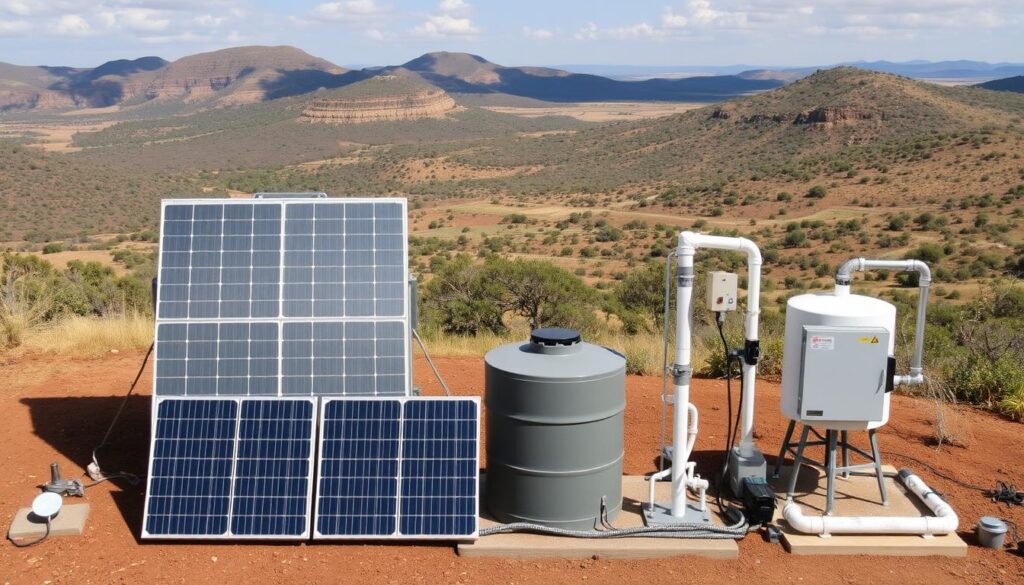
A typical solar borehole system has several key components. These include solar panels, a submersible pump, and a controller or inverter.
Other essential parts are mounting equipment, cables, and connectors. The system may use 18 100W panels or 4 500W panels for a 1Hp pump.
- Solar panels (18 x 100W or 4 x 500W for a 1Hp pump)
- Submersible pump (3-inch for small boreholes, 4-6 inch for domestic use)
- Controller or inverter
- Mounting equipment
- Cables and connectors
Benefits of Solar-Powered Water Pumping
Solar-powered water extraction offers many advantages. These include significant energy savings and the ability to operate off-grid.
The system also boasts low maintenance costs. Solar panels can last up to 30 years, making them a long-term investment.
- Significant energy savings
- Off-grid operation capability
- Low maintenance costs
- Long lifespan (up to 30 years for solar panels)
Key Performance Factors and Efficiency Metrics
Several factors affect an energy-efficient borehole pump setup. These include sunlight availability, pump efficiency, water pH level, and sand content.
| Factor | Optimal Range |
|---|---|
| Sunlight availability | 6-8 hours daily |
| Pump efficiency | Up to 85% (pump and motor combination) |
| Water pH level | 6.5 – 8.5 |
| Sand content | Maximum 1‰ |
The cost of solar-powered water extraction varies by system size and borehole depth. A 5kW solar borehole system costs about R105,000.
This system can save R23,100 yearly. The payback period is roughly 4.5 years, making it a cost-effective choice.
Solar Borehole Pump Installation Prices
Solar pump installation costs for boreholes in South Africa vary widely. Factors like system capacity and component quality influence the price. Let’s explore the costs in detail.
Solar borehole pump package prices depend on power output. A 2kW system costs about R63,000, whilst a 10kW system reaches R188,000. These prices cover all components and installation.
Here’s a detailed breakdown of costs for different system capacities:
| System Capacity | Approximate Cost |
|---|---|
| 2kW | R63,000 |
| 3kW | R74,000 |
| 5kW | R110,000 |
| 10kW | R188,000 |
The solar pump controller installation cost is a key price factor. High-quality controllers can cost between R10,000 and R30,000. Their features and capacity affect the price.
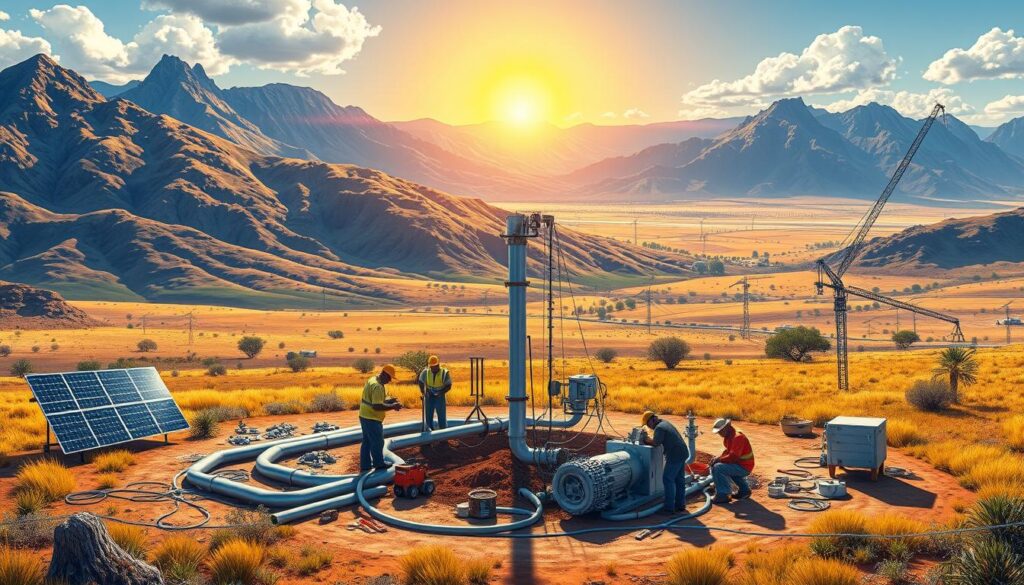
The Grundfos SQFlex series offers excellent pump options. The SQF 0.6-2 (1.4 kW) costs R36,469. The more powerful SQF 5-70 N (2.5 kW) is priced at R50,460.
These pumps provide flow rates from 0.1 m³/hr to 3.75 m³/hr. They can handle head capacities up to 230m. Despite the upfront cost, solar borehole pumps offer long-term energy savings.
Regional Price Variations Across South African Provinces – Solar Borehole Pump Installation Prices
Solar borehole pump installation prices differ greatly across South African provinces and between urban and rural areas. We’ve examined the costs to provide a clear picture of solar water pump system installation expenses.
Urban vs Rural Installation Costs
In urban areas like Johannesburg and Pretoria, solar borehole pump installations are pricier. A complete 150m borehole system can cost between R60,000 and R120,000 in these cities.
Higher labour and transport expenses in cities contribute to this price difference.

Provincial Price Differences
Borehole solar pump costs vary across South African provinces:
- Gauteng: R83,000 – R125,000
- Limpopo: R90,000 – R150,000
- KwaZulu-Natal and Mpumalanga: R75,000 – R180,000
- Eastern Cape: R90,000 – R210,000
Geology, accessibility, and local demand influence these price variations. In Limpopo, high rural demand drives up prices.
Groundwater supplies 70% of domestic water in this province.
Transport and Labour Cost Impact
Transport and labour costs greatly affect solar water pump installation prices. In Pretoria, basic installation packages start at R40,000, while premium options can reach R100,000.
Drilling costs range from R500 to R1,500 per metre. The final installation price depends on depth and ground conditions.
| Component | Cost Range |
|---|---|
| Geophysical survey | R5,000 – R15,000 |
| Site preparation | R2,000 – R5,000 |
| Pump installation | R2,000 – R5,000 |
Knowing these regional differences helps you budget for your solar borehole pump installation. This applies whether you’re in Johannesburg, Pretoria, or elsewhere in South Africa.
System Sizing and Power Requirements – Solar Borehole Pump Installation Prices
Sizing a solar borehole pump system correctly is vital for top performance. Our guide looks at water needs, solar panel size, and pump choice based on borehole depth.
Calculating Water Demand
Water needs change based on use. Homes often need 1-2 kW systems. Small farms require 3-5 kW, while large farms need 6+ kW.
The Grundfos SQFlex range offers flow rates from 0.1 to 3.75 m³/hr. This range meets many different needs.
Solar Panel Capacity Planning
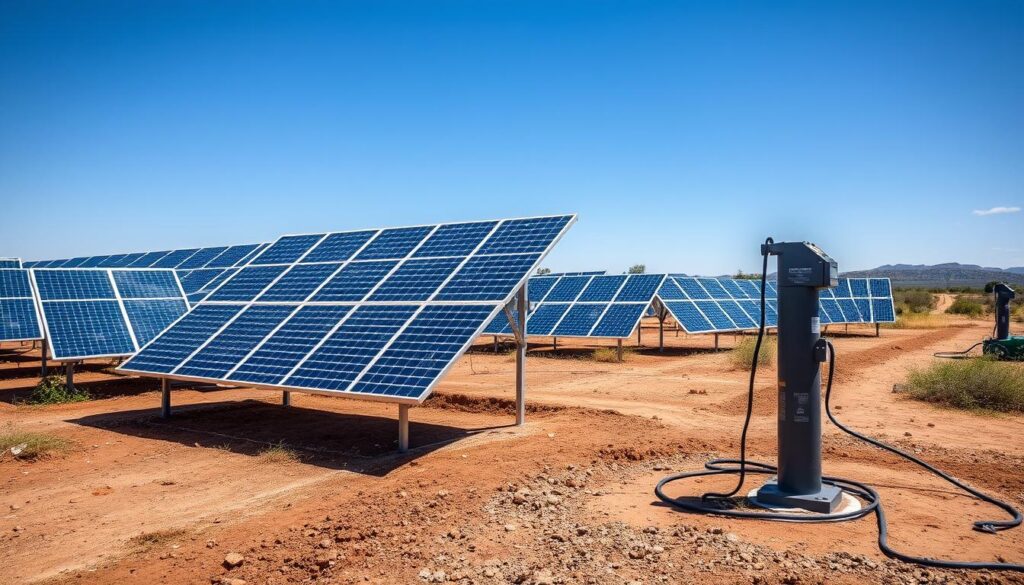
For good energy output in South Africa, we suggest 450W panels or higher. A 1.1kW pump needs about 1,760 watts of power.
This means 18 100-watt panels or 4 500-watt panels. It’s smart to choose panels with 60% more power than the motor’s rating.
Pump Selection Based on Borehole Depth
Pump depth needs are key for system efficiency. For 30-50m depths, a 0.75 – 1 HP pump (R15,000 – R25,000) works well.
Depths of 50-80m need a 1 – 1.5 HP pump (R25,000 – R35,000). For 80-100m depths, use a 1.5 – 2 HP pump (R35,000 – R45,000).
The Grundfos SQFlex can handle heads from 10m to 230m.
| Depth (m) | Pump Power (HP) | Price Range |
|---|---|---|
| 30-50 | 0.75 – 1 | R15,000 – R25,000 |
| 50-80 | 1 – 1.5 | R25,000 – R35,000 |
| 80-100 | 1.5 – 2 | R35,000 – R45,000 |
Cost Factors and Component Breakdown – Solar Borehole Pump Installation Prices
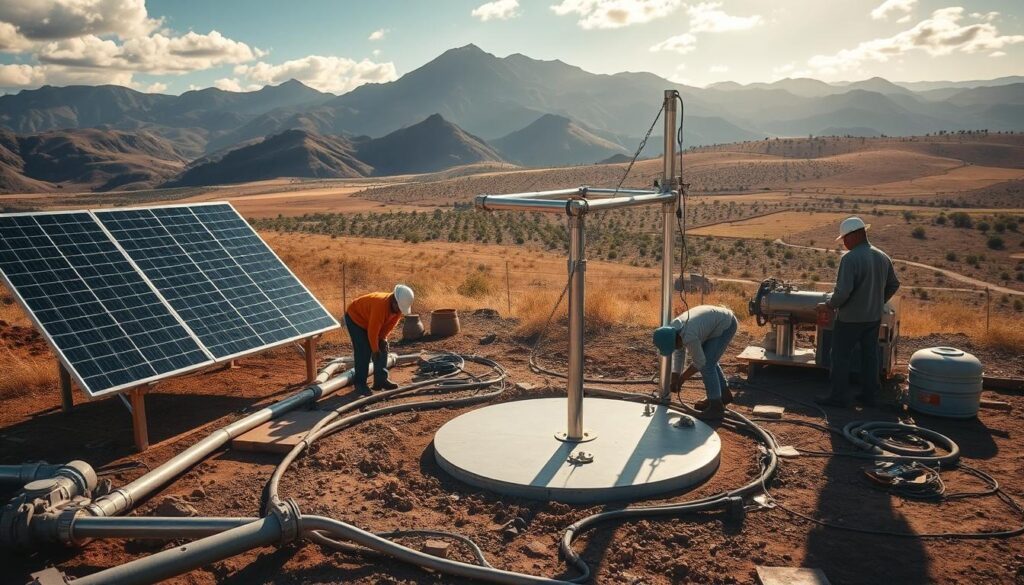
Solar borehole system prices in South Africa depend on several factors. Borehole depth, ranging from 12 to 400 metres, plays a big role. System size and installation complexity also affect the final cost.
Borehole solar panel costs vary based on type and efficiency. Monocrystalline panels, best for solar-powered pumps, cost between R2,000 to R3,700 for 330-370 Watt models. Polycrystalline and thin-film options have similar prices.
Pump selection is vital, with submersible models costing R3,700 to R18,500. Surface water pumps start at R9,300. The choice depends on borehole depth and water needs.
For best results, pumps should be placed 2 to 5 metres from the borehole bottom.
| Component | Price Range |
|---|---|
| Solar Panels (330-370W) | R2,000 – R3,700 |
| Submersible Pump | R3,700 – R18,500 |
| Surface Water Pump | R9,300+ |
| Pump Controller | R3,700 – R18,500 |
| Solar Inverter | R3,700+ |
Other costs include pump controllers (R3,700 – R18,500) and solar inverters (from R3,700). Battery storage is optional but can raise system costs. Regular upkeep, including checks every four months, ensures long life and follows local rules.
Installation Process and Timeline – Solar Borehole Pump Installation Prices
Solar borehole pump installation in South Africa requires careful planning. We’ll guide you through the key stages, from initial assessment to final commissioning.
Site Assessment and Planning
The first step is a thorough site assessment. This crucial phase typically takes 1-2 days and costs R5,000-R15,000. Experts conduct geophysical surveys to determine the best drilling location.
They also assess the potential water yield. This information is vital for the project’s success.
Equipment Setup and Configuration
After assessment, drilling begins. This phase can last 2-5 days, depending on the required depth. Typical depths range from 30 to 200 metres.
Drilling costs vary between R10,500 and R100,000. The price depends on depth and ground conditions.
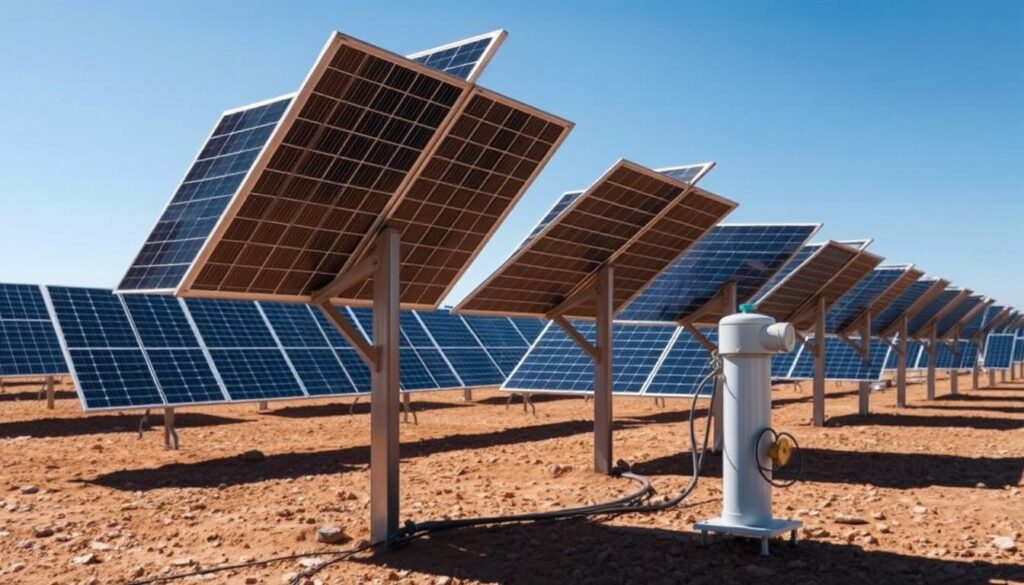
Next, the solar pump system is installed. This stage usually takes 1-2 days and costs R5,000-R25,000. It includes setting up the pump, solar panels, and control systems.
Testing and Commissioning
The final stage involves testing the solar-powered water extraction system. This process typically takes one day and costs R1,500-R3,000. Technicians ensure all components work correctly.
They also check if the system produces the expected water yield. This step is crucial for system reliability.
The entire installation process usually spans 1-2 weeks. While initial costs are high, it’s a long-term investment. With proper care, these systems can provide water for 50-80 years.
This makes solar borehole pumps a cost-effective solution for many South African households and businesses.
Solar Borehole Pump Installation Prices: Conclusion
Solar borehole pump installations in South Africa offer a cost-effective solution for sustainable water access. Prices range from R63,000 to R188,000, providing long-term benefits despite initial costs. The Ceva 100 Solar DC Borehole Pump is crucial in rural areas and farms with limited water access.
These systems can deliver up to 1,000% more water than traditional alternatives, depending on weather. They also offer energy savings of 15% to 30% with permanent magnet brush-less synchronous motors. Some models need maintenance only once every 20 years, making them a wise investment.
The impact of solar borehole pumps is evident in South African villages. Mashete Village now uses 28 new solar modules instead of 35. Mienje enjoys 23% more water output with the same number of modules.
Well-maintained systems can last up to 25 years. They offer a reliable, sustainable water solution for South African residents and businesses. Solar borehole pumps ensure long-term water security while reducing reliance on grid electricity.
The growing demand for sustainable water sources highlights the importance of this technology. By investing in solar borehole pumps, South Africans can secure their water future. These systems significantly reduce dependence on traditional fuel sources and grid electricity.
FAQ
1. What is the average cost of a solar borehole pump installation in South Africa?
Solar borehole pump installation costs in South Africa vary by system size. In 2026, prices range from R63,000 for a 2kW system to R188,000 for 10kW. A typical 5kW system costs about R110,000.
2. How long does it take to recover the investment in a solar borehole pump system?
The return on investment for a solar borehole pump system takes 4 to 6 years. Families can save between R19,800 and R26,400 yearly on electricity bills. This contributes to the quick payback period.
3. What are the essential components of a solar borehole system?
A solar borehole system includes solar panels, a submersible pump, and a controller or inverter. It also needs mounting equipment, cables, and connectors. The pump size varies based on borehole dimensions and usage.
4. How long do solar borehole pump systems last?
Solar panels in these systems can last up to 30 years. With proper care, the entire system can provide reliable water for 25 years. This long lifespan makes them a smart choice for South African residents.
5. How does the cost of installation differ between urban and rural areas?
Urban areas like Johannesburg often have higher installation costs due to labour and transport expenses. Rural areas may have lower prices, but accessibility can affect overall costs. In the North West Province, complete systems cost between R60,000 and R120,000.
6. What factors affect the performance of a solar borehole pump system?
Key performance factors include sunlight availability and pump efficiency. Borehole depth and water quality also play a role. The ideal pH range is 6.5 – 8.5, with a maximum 1‰ sand content.
7. How do I determine the right size system for my needs?
System sizing depends on water requirements. Households typically need 1-2 kW systems, while small farms require 3-5 kW setups. Large agricultural operations need 6+ kW systems. Borehole depth also affects pump power requirements.
8. What is the cost breakdown for a solar borehole pump installation?
Costs include inverters (R10,000 – R30,000) and PV panels (R24,000 – R35,000). Mounting kits (R2,800 – R20,000) and installation (R10,000 – R18,000) are also needed. Additional costs may include batteries and regulatory compliance fees.
9. How long does the installation process take?
The installation process typically takes 1-2 weeks. This includes site survey, drilling, pump installation, and system testing. Geophysical surveys take 1-2 days, while drilling can last 2-5 days.
10. Are there any maintenance costs associated with solar borehole pump systems?
Solar borehole pump systems have low maintenance costs compared to traditional ones. Regular check-ups and cleaning of solar panels are recommended. Specific maintenance costs vary depending on system size and complexity.

